



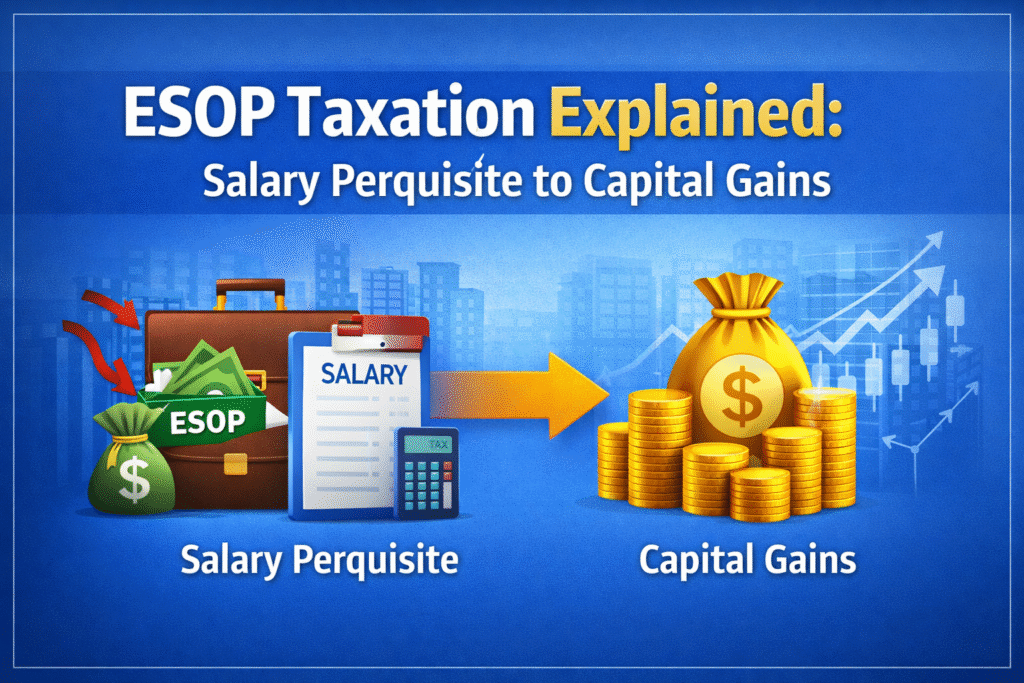
ESOP Taxation Explained: Salary Perquisite to Capital Gains
In today’s competitive job market, companies are constantly looking for ways to attract, retain, and motivate talented employees. One powerful tool that many organizations use is the Employee Stock Option Plan (ESOP). ESOPs not only reward employees but also make them feel like true stakeholders in the company’s success.
When a company gives shares to an employee under ESOP at a low price or free, it is treated as a taxable benefit in the year the shares are given. For eligible start-ups, tax payment can be delayed. The value is the market price on exercise minus the amount paid. Profit on sale is taxed as capital gains.
1. What is an Employee Stock Option Plan (ESOP)?
An Employee Stock Option Plan (ESOP) is a benefit scheme under which a company grants its employees the option to buy company shares at a predetermined price after a certain period. This price is usually lower than the future market value of the shares.
Simply put, ESOPs give employees the right, but not the obligation, to become part-owners of the company.
2. How Does ESOP Work?
An ESOP generally follows these stages:
- Granting of Options
The company offers stock options to employees as part of their compensation package.
- Vesting Period
Employees must stay with the company for a specific period (for example, 3–4 years) to earn the right to exercise their options.
- Exercise of Options
Once vested, employees can purchase shares at the agreed exercise price. - Selling the Shares
Employees may later sell these shares (subject to company rules) and earn profits if the share value has increased.
3. Key Terms Related to ESOP
Understanding ESOPs becomes easier when you know these basic terms:
- Grant Date: The date when options are offered to employees.
- Vesting Period: The time an employee must work before exercising options.
- Exercise Price: The price at which employees can buy the shares.
- Lock-in Period: The minimum time shares must be held before selling (if applicable).
4. Eligible Start-up and ESOP
To support innovation and entrepreneurship, the Income Tax Act provides special relief to employees of eligible start-ups.
An eligible start-up is a government-recognized start-up that fulfills prescribed conditions relating to innovation, age of business, and approval under the Income Tax Act.
Special ESOP Benefit for Eligible Start-ups
For employees of eligible start-ups:
ESOP perquisite is taxable, but the payment or deduction of tax is deferred.
Tax becomes payable at the earliest of:
Sale of ESOP shares
Employee leaving the company
Completion of the specified time period
This provision reduces the immediate tax burden on employees
4. Benefits of ESOP
For Employees: - Wealth Creation: Employees can gain financially if the company grows.
- Sense of Ownership: ESOPs create a feeling of belonging and responsibility.
- Motivation: Employees are more motivated to contribute to company success.
For Employers:
- Talent Retention: Vesting periods encourage employees to stay longer.
- Employee Engagement: Ownership leads to higher commitment and productivity.
- Cash Flow Advantage: ESOPs reduce immediate cash salary pressure.
5. Limitations of ESOP
Despite its benefits, ESOPs also have certain drawbacks:
- Market Risk: Share value may not always increase.
- Liquidity Issues: Employees may face difficulty selling shares in private companies.
- Complexity: Legal and tax regulations can be complicated.
6. ESOP in Startups vs Large Companies
- Startups often use ESOPs to attract talent when they cannot offer high salaries.
- Large companies use ESOPs as long-term incentive plans to reward performance and loyalty.
7. Taxation of ESOP (Brief Overview)
ESOPs are taxed at two stages:
- At Exercise: Difference between market value and exercise price is treated as income.
- At Sale: Capital gains tax applies when shares are sold.
(Tax rules vary by country and may change over time.)
8. Conclusion
An Employee Stock Option Plan is more than just a financial benefit—it is a strategic tool that aligns employee interests with company growth. When designed and communicated effectively, ESOPs can create a win-win situation for both employers and employees.
9. Example
Example. Rahul works in a company that offers him 100 shares under ESOP.
Exercise price: ₹50 per share
Market value on exercise date: ₹150 per share
Perquisite value (Salary income)
Perquisite = (Market value − Exercise price) × Number of shares
= (₹150 − ₹50) × 100
= ₹10,000
This ₹10,000 is taxable as salary (perquisite).
Later Sale of Shares
Rahul sells the shares at ₹200 per share.
Sale value = ₹200 × 100 = ₹20,000
Cost for capital gains = ₹150 × 100 = ₹15,000
Capital Gain = ₹5,000, taxable under Capital Gains.
FAQs
ESOP is taxable as a perquisite in the year the employee exercises and receives the shares.
It is calculated as market value of shares on the exercise date minus the amount paid by the employee.
Yes, but in case of an eligible start-up, the payment of tax on ESOP perquisite is deferred.
When the employee sells the ESOP shares, the profit earned is taxed under Capital Gains.
.
No. It is taxed as salary at exercise and as capital gains at sale, but on different amounts.