



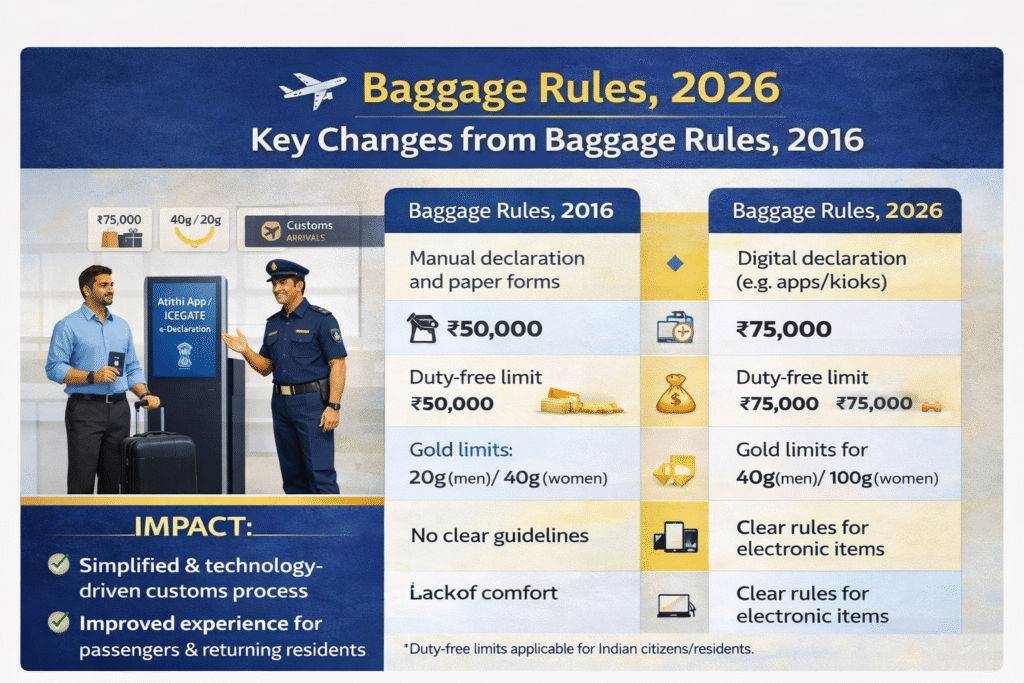
Duty-Free Limits Increased: A Look at Baggage Rules, 2026
The Government of India has notified the Baggage Rules, 2026, effective from 2nd February 2026, replacing the earlier Baggage Rules, 2016. The revised framework aims to simplify customs procedures, enhance passenger convenience, and align duty-free allowances with present-day travel and economic realities.
- Enhanced General Duty-Free Allowance
One of the most significant updates under the 2026 Rules is the increase in duty-free limits:
Category 2016 Rules 2026 Rules
Resident / Tourist of Indian Origin ₹50,000 ₹75,000
Foreigner (Non-tourist visa) ₹50,000 ₹75,000
Tourist of Foreign Origin ₹15,000 ₹25,000
Crew Members ₹1,500 ₹2,500Note: Passengers arriving via land borders continue to have no general duty-free allowance.
This enhancement reflects inflation adjustments and the increase in international travel. - Transfer of Residence (TR) – Simplified Framework
Under the 2016 Rules, Transfer of Residence benefits were governed by a complex item-wise concession list.
The 2026 Rules introduce a value-based rationalized structure, simplifying compliance:
Stay abroad up to 12 months – ₹1.5 lakh
Stay abroad 1–2 years – ₹3 lakh
Stay abroad above 2 years – ₹7.5 lakh
The move from item-specific limits to an overall value cap significantly reduces ambiguity and administrative burden.
- Jewellery Allowance – Removal of Value Cap
Previously, jewellery allowance was subject to both weight and value caps, leading to valuation disputes.
Under the 2026 Rules:
Female passengers – Up to 40 grams
Other passengers – Up to 20 grams
Value cap removed
This reform brings clarity and reduces litigation and discretionary interpretation at customs clearance points.
- Explicit Recognition of Laptop & Pets
The 2026 Rules formally incorporate: Duty-free import of one laptop (for passengers above 18 years)
Provisions relating to pets, subject to applicable regulations
Earlier, these were governed largely through circulars and clarifications.
- Temporary Import / Re-import Mechanism
A structured framework for issuance of temporary baggage import/export certificates has been introduced. This facilitates smoother handling of goods carried temporarily, reducing detention and compliance issues.
7. Digital & Procedural Reforms
6. Digital & Procedural Reforms
The 2026 framework also introduces: Electronic and advance baggage declarations Consolidation of 35 earlier circulars into a Master Circular Clear operational regulations under the Customs Baggage (Declaration and Processing) Regulations, 2026
This marks a shift toward digitalization and uniform implementation across customs formation. Practical Impact for Travelers & NRIs
The revised Baggage Rules, 2026 bring: Higher duty-free limits Simplified Transfer of Residence benefits
a) Reduced valuation disputes
b) Faster customs clearance
c) Greater procedural transparency
For returning residents, NRIs, international travelers, and professionals advising on customs compliance, these changes provide clarity and ease of implementation.rning residents, NRIs, international travellers, and professionals advising on customs compliance, these changes provide clarity and ease of implementation.
Conclusion
The Baggage Rules, 2026 represent a modernized customs framework aligned with current travel patterns and economic conditions. By increasing limits, simplifying provisions, and introducing digital processes, the Government has taken a facilitative approach while maintaining regulatory oversight.