



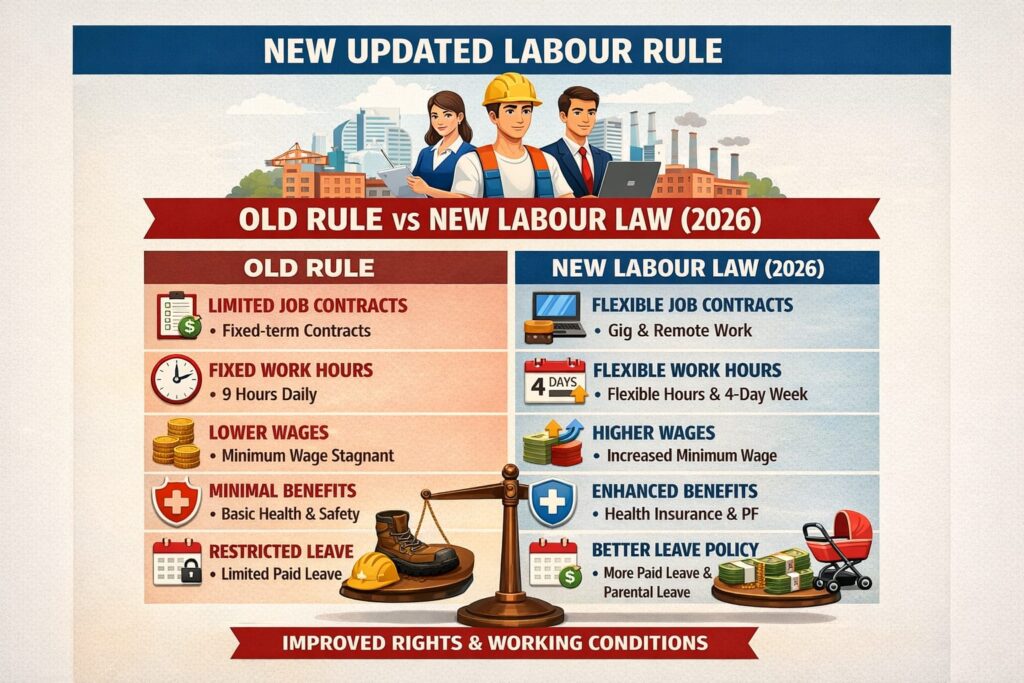
📘 NEW UPDATED LABOUR RULES (INDIA 2026)
Labour laws in India were earlier governed by 29 different Acts, which created confusion and compliance difficulties. To simplify and modernize the system, the Government of India introduced 4 new Labour Codes, implemented around 2025–2026.
These new laws aim to ensure:
• Transparency
• Uniformity
• Better worker protection
• Ease of doing business
🔹OLD LABOUR LAWS (BEFORE 2026)
📌 Features:
• 29 separate labour laws
• Complex and overlapping rules
• Different definitions of wages
• Limited social security coverage
• Minimum wages only for selected sectors
• Strict compliance procedures
❌ Problems:
• Difficult for employers to follow
• Workers lacked awareness
• Legal disputes were common
• No coverage for gig workers
🔹 NEW LABOUR LAWS (2026)
The government combined 29 laws into 4 Labour Codes:
1. Code on Wages (2019)
• Uniform definition of wages
• Minimum wages for all workers
• Introduction of national floor wage
2. Code on Social Security (2020)
• Covers employees, gig workers, and platform workers
• Includes PF, pension, insurance, maternity benefits
3. Industrial Relations Code (2020)
• Simplifies rules for hiring and firing
• Increases threshold for layoffs (up to 300 workers)
• Introduces fixed-term employment
4. Occupational Safety, Health and Working Conditions Code (2020)
• Ensures worker safety and health
• Provides better working conditions
• Applicable across industries
🔹 KEY DIFFERENCES: OLD vs NEW
💰 1. WAGES
• Old: No standard definition
• New: Basic wage must be at least 50% of total salary
👉 Impact:
• Higher PF and gratuity
• Lower take-home salary (in some cases)
👷 2. MINIMUM WAGES
• Old: Only for certain jobs
• New: Applicable to all workers🧾 3. SOCIAL SECURITY
• Old: Only formal workers covered
• New: Includes gig workers (Swiggy, Uber, etc.)
🎁 4. GRATUITY
• Old: After 5 years of service
• New: Fixed-term employees eligible after 1 year⏰ 5. WORKING HOURS
• Old: Fixed daily hours (~9 hours)
• New: Flexible (up to 12 hours/day), max 48 hours/week
🏭 6. COMPANY RULES
• Old: Strict rules for layoffs
• New: Easier hiring and firing (up to 300 employees without approval)👩💼 7. WOMEN EMPLOYEES
• Old: Restrictions on night shifts
• New: Allowed with safety measures🔹 ADVANTAGES OF NEW LABOUR LAW
✅ For Employees:• Universal minimum wage
• Better social security
• Increased retirement benefits (PF, gratuity)
• Equal pay for men and women
✅ For Employers:
• Simplified compliance
• Reduced paperwork
• Flexibility in workforce management
🔹 DISADVANTAGES
• Reduction in take-home salary
• Easier layoffs may reduce job security
• Implementation varies across states
📌 CONCLUSION
The New Labour Laws 2026 are a major reform in India’s labour system. They replace outdated and complex rules with a simplified, modern, and uniform framework.
While they improve social security and ease of business, concerns about job security and salary structure remain.