



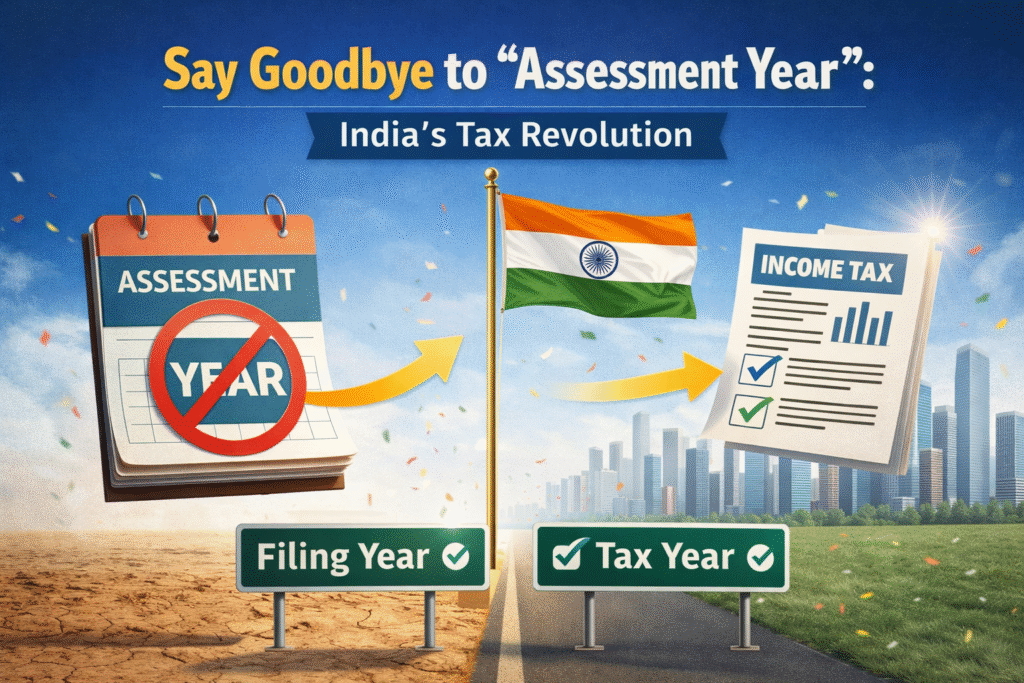
Filing taxes in India just got a lot simpler! The Income-tax Act, 2025 has introduced a major shift : replacing the confusing “Assessment Year” (AY) with the intuitive Tax Year (TY).
This shift is aimed at reducing confusion and aligning India’s tax terminology with global practices.
Understanding the Existing Concept: Financial Year & Assessment Year
Under the Income-tax Act, 1961, taxation follows a two-year reference system:
• Financial Year (FY):
The year in which income is earned
(Example: FY 2024–25)
• Assessment Year (AY):
The subsequent year in which income is assessed and taxed
(Example: AY 2025–26)
Challenges with AY Concept
• Confusion among taxpayers (especially non-professionals)
• Frequent errors in return filing
• Complexity in communication and compliance
• Difficulty for first-time taxpayers.
Introduction of ‘Tax Year’ under the Income-tax Act, 2025
The Tax Year (TY) replaces both the Financial Year and Assessment Year distinction for tax purposes.
• Tax Year:
The year in which income is earned and taxed.
Example:
Income earned during 1 April 2026 to 31 March 2027 will be referred to as Tax Year 2026–27, and tax will also be calculated for the same period.
Key Differences: Tax Year vs Assessment Year
Particulars | Assessment Year (Old Regime) | Tax Year (New Regime) |
|---|---|---|
Basis | Year of assessment | Year of earning |
Timeline | One-year lag (FY + AY) | No lag |
Complexity | Higher | Lower |
Understanding | Confusing for many | Simple & intuitive |
Global Alignment | Limited | Aligned with global practices |
🔍 Why This Change Matters?
1. Simplification for Taxpayers
Taxpayers no longer need to track two different years. A single reference point improves clarity.
2. Reduction in Errors
Eliminates confusion while filing returns, notices, and tax computations.
3. Ease of Compliance
Professionals and businesses can streamline reporting and documentation.
4. Better Communication
Government notices, forms, and compliance requirements become easier to interpret.