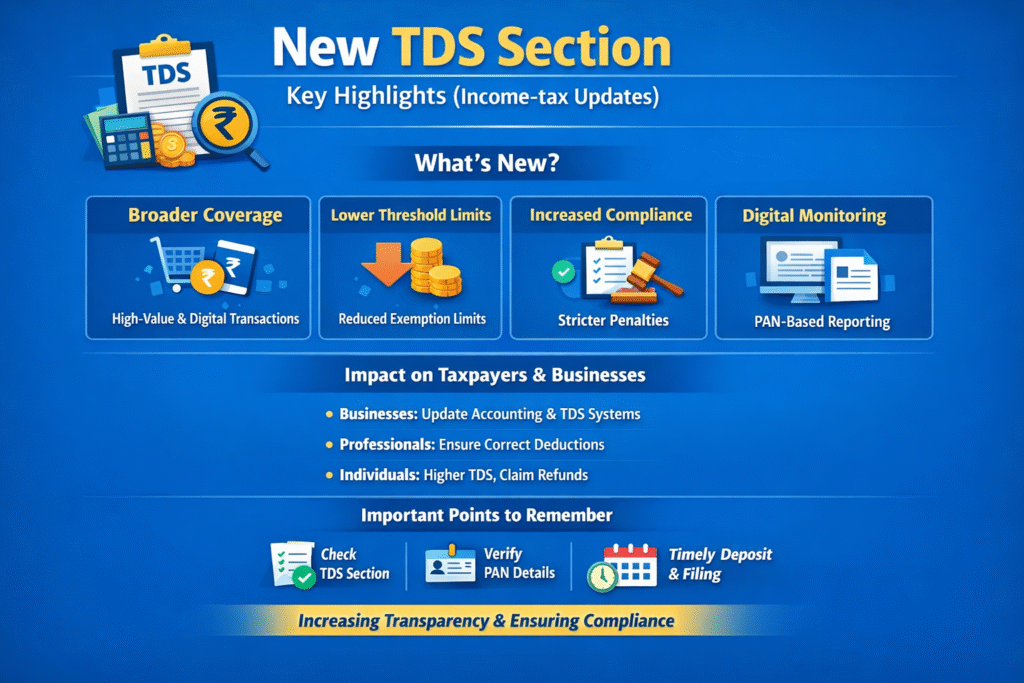
Tax Deducted at Source (TDS) continues to be a critical compliance mechanism under the Income Tax framework, ensuring timely collection of taxes at the point of income generation. With evolving provisions applicable for Tax Year 2026–27, it is essential for professionals, businesses, and taxpayers to stay updated with the latest rates, thresholds, and applicable sections.
This blog provides a structured overview of key TDS provisions, especially focusing on professional payments, NRI transactions, and other relevant categories.
Understanding the Structure of TDS in Tax Year 2026–27
TDS provisions are broadly categorized into three segments:
1. Salary Payments (Section 392)
Applicable on salary income paid to employees.
Deduction is based on average income tax rate applicable to the employee.
Includes:
• Government employees
• Private employees
• PF withdrawals. (specific cases @ 10%)
👉 Key takeaway: Salary TDS is not fixed-rate based—it depends on estimated annual income.
2. Non-Salary Payments (Residents) – Section 393(1)
This is the most extensive category, covering day-to-day business transactions.
Key Coverage Areas:
A. Commission & Brokerage
• Insurance & other commission → 2%
• Threshold → ₹20,000
B. Rent Payments
• Rent (Individual/HUF) → 2%
• Rent (Plant & Machinery) → 2%
• Rent (Land/Building) → 10%
• Threshold → ₹50,000 per month
C. Immovable Property Transactions
• Transfer of property → 1%
• Joint Development / Compensation → 10%
D. Interest Income
• Securities → 10%
• Bank/Post Office:
• Senior Citizens → ₹1,00,000 threshold
• Others → ₹50,000 threshold
E. Contract & Professional Payments Contractors:
• Individual/HUF → 1%
• Others → 2%
• Professional Services → 10%
• Technical Services → 2%
• Threshold:
→ ₹30,000 (contract)
→ ₹50,000 (professional)
F. Special Transactions
• Purchase of Goods → 0.1%
• E-commerce Participants → 0.1%
• Virtual Digital Assets (VDA) → 1%
• Dividend → 10%
👉 Key takeaway: Correct classification is critical—misclassification can lead to short deduction and penalties.
3. Non-Salary Payments (Non-Residents) – Section 393(2)
Payments to NRIs attract special TDS rates, often subject to treaty benefits.
Major Transactions Covered:
A. Interest on foreign currency loans → 5%
B. Income from units → 10%
C. Long-term capital gains → 10% / 13%
D. Securities & bonds → 10% / 20%.
👉 Key takeaway: Always evaluate DTAA provisions before applying TDS rates.
4. Special Category Payments (Any Person) – Section 393(3)
These are high-rate or exceptional transactions:
A. Nature of Payment TDS Rate
B. Lottery / Gambling / Online Gaming 30%
C. Horse Race Winnings 30%
D. Cash Withdrawal (beyond limits) 2%
E. Payment to Partner 10%.
👉 Key takeaway: These transactions are strictly monitored and heavily taxed.
📌 Critical Compliance Checks for Tax Year 2026–27
✔ Ensure PAN availability, else higher TDS applies
✔ Track threshold limits carefully
✔ Apply Section 206AB for non-filers
✔ Deduct TDS at correct time of payment/credit
✔ File quarterly TDS returns accurately
📄 Practical Risks Businesses Should Avoid
• Applying wrong section (e.g., 194J vs 194C equivalet)
• Ignoring aggregation for threshold limits
• Deducting TDS on gross instead of taxable portion (especially for NRIs)
• Delayed deposit leading to interest & penalties
✅ Conclusion
The TDS regime for Tax Year 2026–27 is more structured but demands precision. While rates may appear straightforward, the real challenge lies in correct classification, timing, and compliance discipline.
Businesses that proactively align their processes with updated TDS provisions will not only ensure compliance but also avoid unnecessary tax exposure and litigation.