
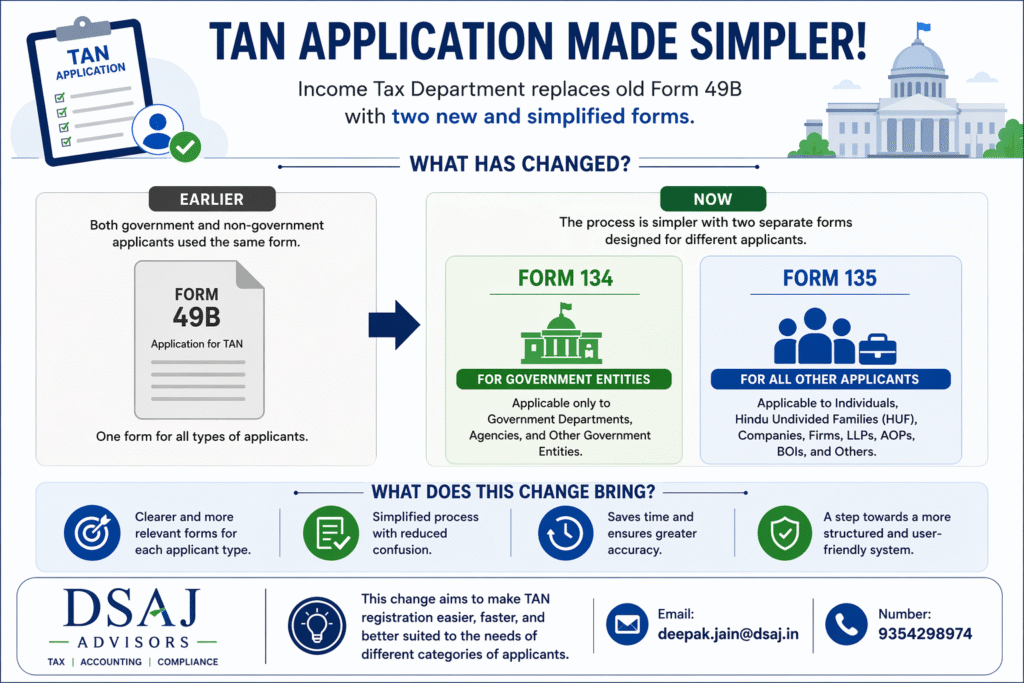
New TAN Forms Alert! Form 134 & 135 replace Form 49B – Know what’s changed.

The Income Tax Department has introduced Form No. 134 and Form No. 135 for the allotment of Tax Deduction and Collection Account Number (TAN), replacing the existing Form 49B. These changes aim to simplify the application process and improve compliance through better documentation and categorization.

Let’s understand the new forms in detail.

🔍 What is TAN and Why is it Required?

TAN (Tax Deduction and Collection Account Number) is a unique 10-digit alphanumeric number required for:

A. Deducting Tax at Source (TDS)
B. Collecting Tax at Source (TCS)
C. Filing TDS/TCS returns
D. Issuing TDS/TCS certificates

Any person or entity responsible for TDS/TCS compliance must obtain TAN.


↗️ Introduction of Form 134 & 135

The earlier Form 49B has now been replaced with two separate forms:

Form No.

Applicable To

Form 134

Government entities

Form 135

Non-Government entities (Individuals, Companies, LLPs, etc.)

This bifurcation ensures category-specific compliance and ease of filing.


🤷🏻‍♀️ Who Should File These Forms?

These forms must be filed by:

A. Individuals deducting TDS
B. Companies and LLPs
C. Government departments
D. Any entity responsible for TDS/TCS compliance
E. Structure of the Forms

Both forms are designed to be simple and self-explanatory, consisting of:

1. Part A – Applicant Details
1. Name of deductor/collector
2. Address
3. PAN (mandatory for non-government applicants)
4. Category of applicant

2. Declaration Section
Signature with date and place


🎯 Key Changes Introduced

1. Separate Forms for Better Clarity
Government and non-government applicants now have distinct forms
Eliminates confusion and irrelevant fields.

2. Mandatory PAN for Non-Government Applicants
Ensures better tracking and PAN-TAN linkage.

3. Simplified and User-Friendly Format
Clear instructions
Logical structure
Reduced duplication.

4. Mandatory Supporting Documents

To ensure authenticity, applicants must now submit:

1. Proof of Identity
2. Proof of Address
3. Proof of Date of Birth/Incorporation
4. Specific Changes for Government Entities (Form 134)
5. Mandatory Accounts Office Identification Number (AIN)
6. Details of State and local authority required

Mandatory details of responsible person:
1. Name
2. PAN
3. Mobile number
4. Submission of certificate issued by PAO/ZAO/DTO/CDDO
5. Specific Changes for Non-Government Entities (Form 135)
6. PAN is mandatory
7. LLPs must provide Registration Number
8. Companies must provide CIN (Corporate Identity Number)

Mandatory details of responsible person:
1. Name
2. PAN
3. Clear mention of:
• Date of Birth (for individuals)
• Date of Incorporation (for entities)


🔑 Key Benefits of the New Forms

✔ Simplified compliance
✔ Reduced errors due to clearer structure
✔ Better verification through mandatory documents
✔ Improved transparency and traceability
✔ Category-specific filing for efficiency


📌 Conclusion

The introduction of Form 134 and 135 marks a significant step towards modernizing TAN application procedures. By simplifying the structure and enforcing stricter documentation, the Income Tax Department aims to enhance compliance and reduce processing errors.

Businesses, professionals, and government bodies should familiarize themselves with these new forms to ensure smooth and accurate TAN registration.

Share on

Facebook
Twitter
LinkedIn