



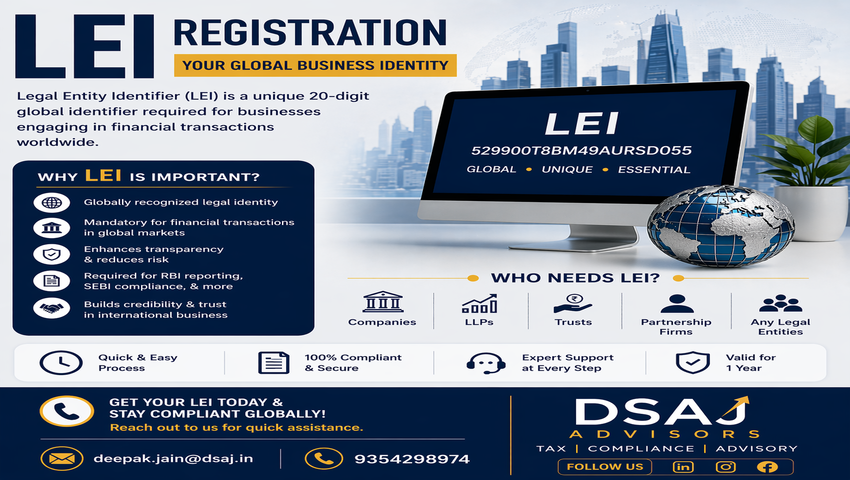
In today’s highly regulated financial ecosystem, transparency and traceability are no longer optional—they are essential. One such global initiative aimed at improving financial transparency is the Legal Entity Identifier (LEI) system.
For businesses in India, especially those engaged in high-value financial transactions or borrowing, LEI registration has become increasingly important—and in many cases, mandatory.
🔍 What is LEI?
A Legal Entity Identifier (LEI) is a unique 20-character alphanumeric code used to identify legally distinct entities participating in financial transactions worldwide.
Governed by: Global Legal Entity Identifier Foundation
Based on: ISO 17442 standard
Example: 5493001KJTIIGC8Y1R12
It acts as a global reference identity for businesses, enabling regulators and financial institutions to track transactions more effectively.
🏛️ Regulatory Framework in India
In India, LEI implementation is guided by the Reserve Bank of India.
LEI is mandatory for:
1. Borrowers with total exposure of ₹5 crore and above
2. Entities undertaking large-value transactions (₹50 crore and above via RTGS/NEFT)
3. Participants in derivative and forex markets
Failure to comply may lead to restrictions on banking transactions.
🎯 Key Benefits of LEI Registration
✅ 1. Enhanced Credibility
An LEI enhances your organization’s credibility with banks, financial institutions, and global counterparties.
✅ 2. Regulatory Compliance
Ensures smooth compliance with RBI guidelines and avoids transaction disruptions.
✅ 3. Improved Transparency
Enables regulators to track financial transactions, reducing the risk of fraud and financial irregularities.
✅ 4. Seamless Banking Transactions
Facilitates quicker processing of loans, RTGS/NEFT transactions, and participation in capital markets.
✅ 5. Global Acceptance
LEI is recognized worldwide, making it essential for entities engaged in international business.
⚠️ Important Considerations
Annual Renewal is Mandatory
LEI must be renewed every year to remain active.
Lapsed LEI = Transaction Restrictions
Banks may block or delay transactions if LEI status is not “Active”.
Applicable to Multiple Entity Types
Includes companies, LLPs, partnerships, trusts, and societies.