
In the dynamic startup ecosystem of India
, seed funding plays a crucial role in transforming innovative ideas
into scalable businesses
. It is often the first formal capital that a startup raises and serves as the foundation for growth, validation, and future fundraising.
For entrepreneurs, understanding the legal
, financial
, and compliance
aspects of seed funding is essentialโnot just to raise funds, but to do so in a structured and compliant manner.
๐ก What is Seed Funding?
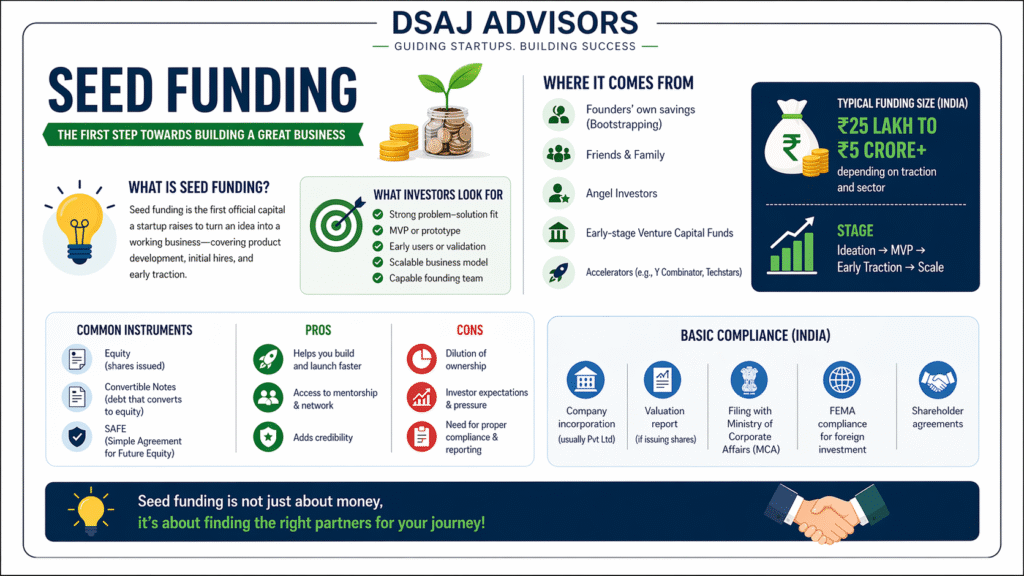
Seed funding refers to the initial capital infusion into a startup to support early-stage activities such as:
๐ ๏ธ Product development
๐ Market research and validation
๐ฉโ๐ผ Initial hiring and operational setup
๐ Achieving early traction
This stage bridges the gap between idea ๐ญ and execution โ๏ธ, helping startups build a Minimum Viable Product (MVP) and validate their business model.
๐ธ Sources of Seed Funding
Startups in India can raise seed capital from multiple sources:
๐ค 1. Bootstrapping (Foundersโ Own Capital)
Self-funding through personal savings reflects strong commitment ๐ช and reduces early dilution.
๐จโ๐ฉโ๐ง 2. Friends and Family
A common early-stage sourceโrequires proper documentation ๐ to avoid future disputes.
๐งโ๐ผ 3. Angel Investors
High-net-worth individuals investing in promising startups ๐ along with mentorship ๐ค.
๐ฆ 4. Venture Capital Funds (Early Stage)
Institutional investors supporting scalable startups with growth potential ๐.
๐ 5. Accelerators & Incubators
Programs like Y Combinator, Techstars provide funding ๐ฐ, mentorship ๐ฏ, and networking ๐.
๐ Typical Funding Size and Stage in India
๐ฐ Funding Range: โน25 Lakhs to โน5 Crores (varies by sector)
๐ Startup Stage:
๐ญ Ideation
๐งช MVP Development
๐ Early Traction
๐ Pre-Series A Readiness
๐ Common Instruments Used in Seed Funding
ย
Choosing the right funding instrument is critical โ ๏ธ:
๐ 1. Equity Shares
Direct ownership exchange ๐
Requires valuation ๐ and compliance
๐ 2. Convertible Notes
Debt that converts into equity later
Useful for delaying valuation discussions
๐ 3. SAFE (Simple Agreement for Future Equity)
Simplified agreement ๐
Increasingly popular in startup ecosystems
ย
๐ฏ What Investors Look For
Investors evaluate startups based on:
โ
Strong problem-solution fit
๐งช MVP or working prototype
๐ Early traction or validation
๐ Scalable business model
๐ฅ Capable founding team
๐ Advantages of Seed Funding
๐ Faster product development & launch
๐ค Access to mentorship & networks
๐ Enhanced credibility
๐ Early customer traction
โ ๏ธ Challenges and Risks
๐ Dilution of ownership
๐ Investor expectations & pressure
๐ Compliance and reporting burden
โณ Growth pressure within timelines
โ๏ธ Key Legal and Compliance Requirements in India
ย
Raising seed funding involves multiple regulatory compliances:
๐ข 1. Company Incorporation
Usually a Private Limited Company
๐ 2. Valuation Requirements
Mandatory valuation ๐ for share issuance
Important for tax compliance
๐๏ธ 3. ROC Filings (MCA)
Filing forms like PAS-3 ๐
Maintaining statutory records
๐ 4. FEMA Compliance
Applicable for foreign investments ๐
Timely RBI filings (e.g., FC-GPR)
๐ค 5. Shareholdersโ Agreement (SHA)
Defines rights, exits, governance
๐ 6. Other Registrations
DPIIT recognition ๐ท๏ธ
GST, PAN, TAN as applicable
๐ฐ Tax Considerations
ย
Startups must evaluate:
โ ๏ธ Angel Tax applicability
๐ Taxation of convertible instruments
๐ Proper valuation documentation
โ
Best Practices for Startups
ย
To ensure a smooth funding journey:
๐ Maintain clean financial records
๐ Ensure proper documentation
๐ Be due diligence ready
๐จโ๐ผ Seek professional guidance
๐ Focus on long-term scalability
ย


